

 Facebook
 X
X
 Pinterest
 Copy Link
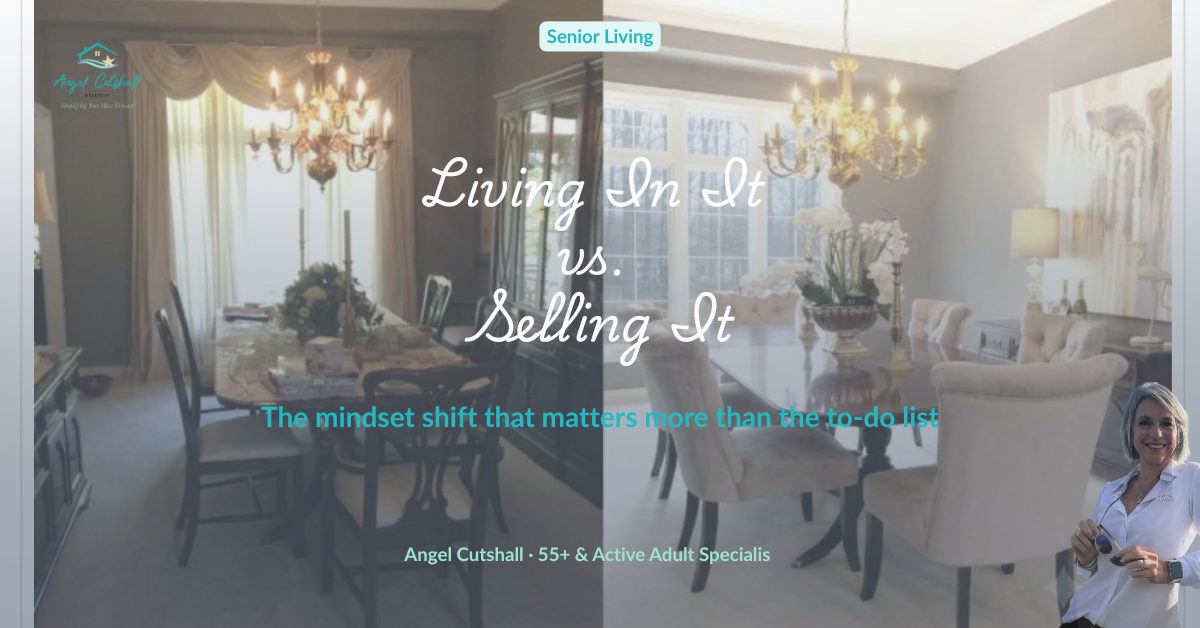
If you’ve lived in your home for twenty, thirty, even forty years, here’s something that might catch you off guard the moment you decide to sell: the home you love living in is not the home that sells for top dollar. And that’s not a criticism of your taste — it’s just how the two jobs work.
Living in a home and marketing one for sale are actually two different goals. One is personal. The other is strategic. And the sooner you separate the two, the easier — and more profitable — your move forward tends to be.
Decorating Tells Your Story. Staging Tells the Buyer’s.
When you decorate a home to live in, everything is chosen around you. The photos on the wall, the chair angled just right toward the window, the paint color you picked because you loved it the second you saw it. That’s not clutter — that’s four decades of a life well lived.
But the moment a home goes on the market, the goal flips. It’s no longer about telling your story. It’s about giving a buyer enough open space, in their mind and in the room, to start imagining their own.
That’s the whole difference between decorating and staging. Decorating is for you. Staging is for them.
The Mindset Shift Nobody Warns You About
Here’s what I’ve noticed after guiding a lot of long-time homeowners through this: the hardest part of getting a house ready to sell is rarely the actual work. It’s the mental shift from “my home” to “the property.”
As long as it still feels like my home in your head, every suggestion — pack away the family photos, clear off the built-ins, maybe even repaint that accent wall — can feel like someone telling you your taste is wrong. It isn’t. It’s just that a buyer needs to see square footage and light and flow, not thirty years of birthday parties and holidays.
The couples I work with who make this shift fastest are the ones who start calling it “the house” or “the property” a few weeks before it goes live. It sounds small. It changes everything about how the process feels.
What This Actually Looks Like in a Long-Held Family Home
For most long-time owners, staging isn’t about buying new furniture or a dramatic redesign. It’s mostly subtraction — clearing out the extra pieces, the personal collections, the decor that tells your story so loudly that a buyer can’t picture their own.
Staging expert Christine Rae, founder of CSP International Staging & Decorating Business Academy, puts it simply: staging is usually “80% subtraction and 20% curation.” A few things that tend to make the biggest difference:A few things that tend to make the biggest difference:
- Removing a meaningful chunk of furniture and personal items to open up sightlines and let rooms breathe
- Rearranging furniture for flow and photos, not for your favorite spot to watch the game
- Packing away family photos, heirlooms, and anything highly personal — this protects your privacy just as much as it helps the sale
- Letting architectural features (windows, built-ins, fireplaces) be the star of the room instead of competing with decor
None of this erases the life you built there. It just clears enough space for a buyer to see themselves in it — which, ultimately, is what gets you the best offer.
You’re Not Losing Your Home — You’re Making Room for the Next Chapter
If you’ve raised a family in your home, hosted every holiday there, or simply built a life inside those walls for decades, packing things up can feel like packing away the memories themselves. It isn’t. The memories go with you. What you’re making room for is what comes next — a lock-and-leave lifestyle, a community full of people your age, more time and less upkeep. (Curious what that next chapter can actually look like? I wrote about one client favorite, Sweetwater by Del Webb, where 20-year-old oak trees already give it a settled feel brand-new construction can’t replicate.)
Stepping back from how a home feels to live in is genuinely one of the harder parts of getting ready to sell. But it’s also usually the first real sign that you’re ready to move forward.
If you’re even starting to think about what selling a long-held family home might look like — whether that’s next month or next year — I’d love to talk through what this shift looks like for your specific situation. No pressure, just a conversation.
This post draws on ideas from Christine Rae’s article, “Why Living in a Home and Selling It Are Opposites,” published on Realty Times.
📞 904-237-6390 📧 angel.jaxhomes@gmail.com 📅 Schedule a conversation: https://calendar.app.google/HyFvoiKWEJGp2LDx9


